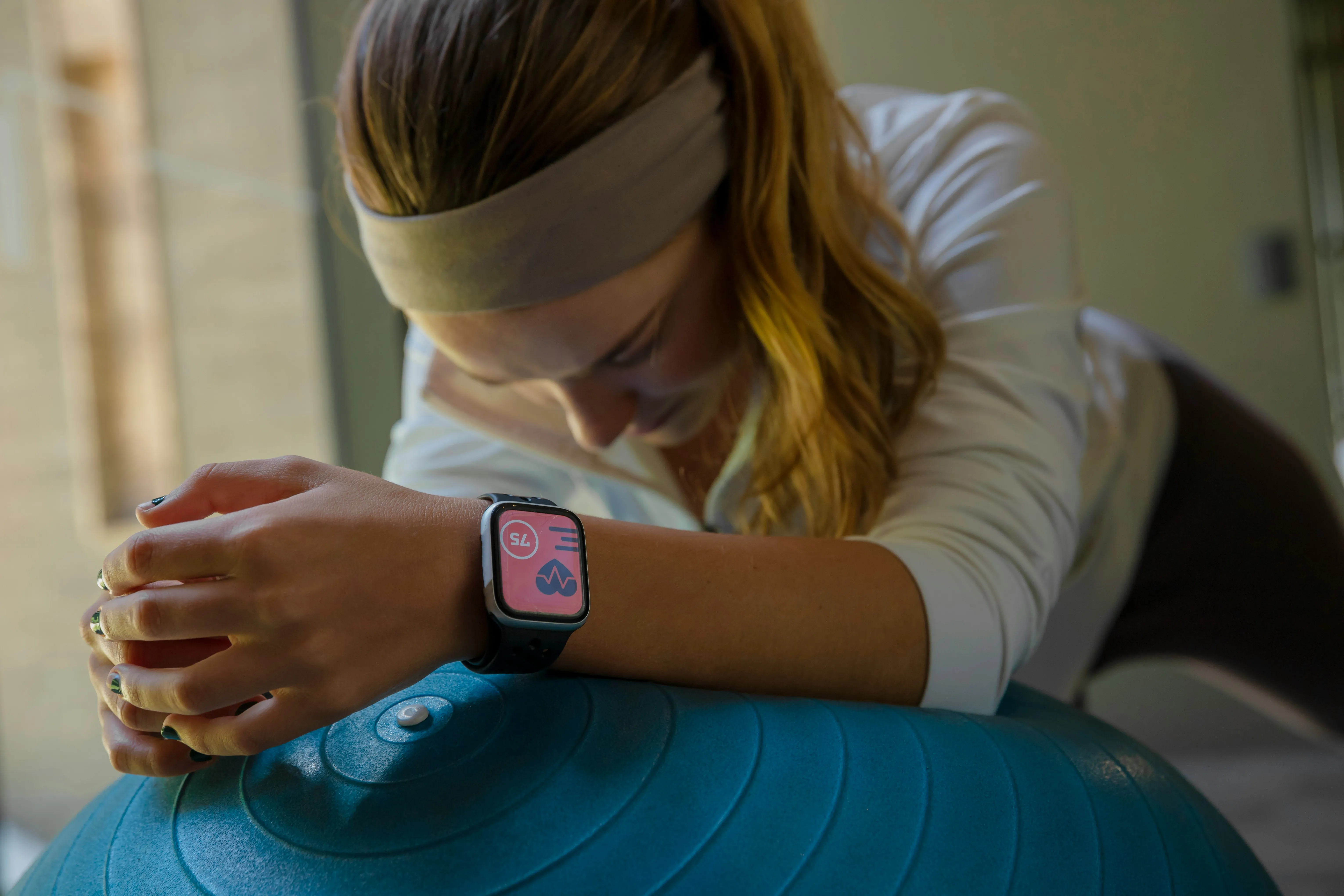
Most fitness advice tells you what to do. Fewer people talk about how to know whether it’s working. You finish a run and wonder if it was hard enough. You take a rest day and wonder if you needed it. You sleep seven hours and assume that was fine. Every training decision becomes a guess, and guesses compound into plateaus, injuries, or burnout.
Data-driven fitness changes the equation. You use objective signals from your body, like heart rate variability, training load trends, heart rate zones, and sleep stages, to answer the questions that matter. Am I recovered? Was that session effective? Am I building fitness or grinding it down?
Data alone isn’t enough, though. The real change happens when checking your numbers becomes as automatic as lacing up your shoes. That’s a habit. It follows the same rules as any other: start small, build a loop, and let consistency do the work.
The data-driven fitness feedback loop
The core of a data-driven fitness habit is a closed feedback loop with four stages: readiness, training load, workout quality, and recovery. Each stage feeds into the next, and over time the loop teaches you how your body actually responds to training.
- Readiness. Check your morning readiness score. It combines overnight HRV, resting heart rate, and sleep quality into a single signal: go hard or take it easy.
- Training load. Track your acute-to-chronic workload ratio to see whether your weekly volume is building fitness or outpacing recovery.
- Workout quality. Use heart rate zones to confirm that easy sessions stay easy and hard sessions stay hard.
- Recovery. Monitor sleep stages and overnight biometrics to see how well your body repaired overnight. That feeds tomorrow’s readiness score.
This loop is the “start knowing” part. Each stage provides a fact that replaces an assumption. And because each stage connects to the next, the whole system gets smarter as your data history grows.
Morning readiness: the one number that shapes your day
Your readiness score is the most actionable data point in your training day. It tells you whether your body has bounced back from yesterday’s stress or is still playing catch-up.
The score draws on overnight biometrics. HRV is the foundation. It reflects the balance between your sympathetic and parasympathetic nervous systems. Higher HRV relative to your personal baseline means your autonomic nervous system is flexible and ready for stress. Lower HRV means it’s already loaded. A 12-month randomized controlled trial at UCLA found that participants who received daily biometric feedback alongside a wearable showed significant improvements in HRV, step count, VO2max, and sleep onset latency compared to those who wore the device without guidance.
Sleeping heart rate and respiratory rate add context. A resting heart rate that drifts five or more beats above your baseline for consecutive days signals cardiovascular strain. Combined with suppressed HRV, this pattern is one of the clearest indicators that you need recovery, not another hard workout.
The habit here is simple: check your readiness score every morning and let it influence your session’s intensity. Research on HRV-guided training consistently shows it matches or outperforms rigid pre-planned programs for aerobic development, with the advantage of reducing the risk of non-functional overreaching.
Training load balance: are you doing enough or too much?
Effort feels subjective. Training load makes it objective. By tracking your workload over time, you get a clear picture of whether your body is adapting or accumulating more fatigue than it can clear.
The acute-to-chronic workload ratio (ACWR) compares your training volume from the past 7 days to your rolling average over the past 28 days. When the ratio stays between 0.8 and 1.3, you’re in the zone where fitness builds without excessive injury risk. A 2025 meta-analysis of 22 cohort studies confirmed that maintaining an ACWR in this range minimized injury incidence, while ratios above 1.5 were associated with substantially higher injury rates.
| ACWR range | Status | What to do |
|---|---|---|
| Below 0.8 | Detraining risk | Gradually increase volume |
| 0.8–1.0 | Recovery | Good for planned deload weeks |
| 1.0–1.3 | Optimal | Building fitness sustainably |
| 1.3–1.5 | Overreaching | Monitor closely, limit duration |
| Above 1.5 | Danger zone | Pull back immediately |
The habit: glance at your training load balance after each workout. It takes seconds and answers one of the hardest questions in training. Do you need to do more, less, or stay the course? Keep weekly load increases under 10 percent to build your chronic fitness base without spiking acute load.
Heart rate zones: training quality, not just quantity
Logging a workout tells you that you trained. Heart rate zones tell you how you trained. And the difference matters more than most people realize.
Zone blindness is one of the most common training mistakes. You go out for an easy run, but without monitoring, your heart rate drifts into Zone 3. That’s tempo territory. Do this repeatedly and every session becomes moderate intensity. You never go easy enough to build your aerobic engine, and you never push hard enough to raise your ceiling. Research supports a polarized approach: roughly 80 percent of training time at low intensity in Zones 1 and 2, and 20 percent at high intensity in Zones 4 and 5, with minimal time in the moderate middle.
After each workout, check your zone distribution. If a recovery run shows significant time above Zone 2, you went too hard. If an interval session never reached Zone 4, you didn’t push enough. This is not about obsessing over numbers. It’s about closing the gap between intention and reality.
Even activities beyond running benefit from zone data. Swimming analytics like SWOLF scores and stroke-by-stroke breakdowns give swimmers the same objective lens. Cycling power and heart rate data help cyclists balance endurance rides with high-intensity efforts. The principle is the same across sports: measure the quality of your effort, not just the fact that you showed up.
Sleep as a training variable, not an afterthought
Sleep is where your body does the actual work of getting fitter. Growth hormone peaks during deep sleep, driving muscle repair and tissue regeneration. Motor memory consolidation, the process that makes new movement patterns stick, happens primarily during REM sleep. Immune function runs repair cycles overnight. Skip or compress these stages and you undercut everything your training is trying to build.
Tracking sleep duration is a start, but sleep stages tell the real story. You can log eight hours in bed while spending only 15 minutes in deep sleep. That’s a recovery problem that total hours won’t reveal. A wearable that breaks sleep into awake time, REM, core sleep, and deep sleep gives you the detail to spot when recovery is happening and when it isn’t.
Overnight biometrics add another layer. Overlaying heart rate, HRV, or respiratory rate on your sleep timeline can reveal patterns like elevated heart rate during specific stages, HRV dips that correlate with late meals or alcohol, or restless periods you don’t remember. These patterns connect directly to next-day readiness. When you see that a poor night of sleep predicts a low readiness score and a sluggish workout, the data makes the case for prioritizing sleep better than any article can.
Consistency over intensity: building the habit layer
Data-driven training works best when it becomes automatic. The goal isn’t to analyze spreadsheets every morning. It’s to build a simple daily rhythm that keeps you connected to the signals that matter.
An activity streak heatmap makes consistency visible. Like a six-month calendar where each active day gets a colored square, it turns abstract consistency into something you can see at a glance. Research from a study of over 1,600 participants found that people who tracked their progress daily were significantly more likely to reach their goals. The visual feedback of an unbroken streak taps into the same motivation loop: don’t break the chain.
Breathwork feeds back into your data in a measurable way. Techniques like diaphragmatic breathing, box breathing, and 4-7-8 breathing activate the parasympathetic nervous system and can improve HRV. Even five minutes of structured breathing before bed improves sleep onset latency and overnight recovery metrics. It’s a low-effort addition to your evening routine that shows up in tomorrow’s readiness score, closing the feedback loop one more time.
The most effective data-driven fitness habits share a pattern. They’re small. They’re tied to an existing routine, like morning coffee, a post-workout cooldown, or bedtime. And they provide immediate, visible feedback. You don’t need to understand every metric. You need a system where checking three or four numbers guides your next decision.
AI coaching: interpretation without the price tag
Raw data is only useful if you know what it means. An AI coach bridges the gap between numbers and action by translating your biometric data into plain-language guidance after every workout.
Different coaching styles serve different needs. An analytical coach might highlight that your Zone 2 time has dropped 15 percent over the past two weeks. A recovery-focused coach might flag a declining HRV trend and suggest an extra rest day. A motivational coach celebrates a new negative split or a personal best training load week. The coaching layer turns passive data into active feedback at a fraction of the cost of a human coach.
The habit angle matters here too. Getting a personalized insight after every session reinforces the loop. You train, you see what the data says, you get guidance on what to do next, and you wake up tomorrow with an updated readiness score. Over weeks and months, this cycle teaches you your body’s patterns better than years of training by feel alone.
How to build a data-driven fitness habit in four weeks
You don’t need to adopt every metric at once. Build the habit in layers.
Week 1: Readiness only. Wear your device overnight and check your readiness score each morning. Don’t change your training yet. Just notice the pattern. Which days score high? Which score low? Start connecting the dots between your lifestyle choices and recovery.
Week 2: Add zone awareness. After each workout, look at your heart rate zone breakdown. Notice where you actually trained versus where you intended to. If your easy days aren’t mostly Zone 1–2, start slowing down.
Week 3: Training load check-in. By now you have enough data for your ACWR to become meaningful. Check it twice a week. Are you in the 0.8–1.3 sweet spot? If you’re creeping above 1.3, schedule a lighter week.
Week 4: Close the loop with sleep. Start reviewing your sleep stages each morning alongside your readiness score. Look for connections: does a night with more deep sleep predict a higher readiness score? Does a late-night screen session show up as more awake time and lower HRV?
After four weeks, the loop is running. Readiness shapes your effort, zones confirm your execution, training load guards your trajectory, and sleep quality feeds back into tomorrow. That’s not a complicated system. It’s four quick check-ins woven into your existing routine.
Build your data-driven fitness habit with Wildgrow
Readiness scores, training load balance, heart rate zones, sleep analysis, and AI coaching. Everything you need to train smarter. Free on the App Store.
Get Early AccessFrequently asked questions
What fitness metrics should I actually track?
Start with four: readiness score (morning), heart rate zones (post-workout), training load balance (weekly), and sleep stages (morning). These cover the full feedback loop of recovery, effort quality, volume management, and overnight repair. Add more only when these feel automatic.
How do I use HRV for training decisions?
Check your HRV-based readiness score each morning. When it’s at or above your personal baseline, train at your planned intensity. When it’s significantly below baseline, swap hard sessions for low-intensity work or rest. The key is comparing to your own trends, not to population averages.
Is data-driven training only for serious athletes?
No. The feedback loop of readiness, training load, zones, and sleep applies whether you’re training for a marathon or trying to stay consistent with three workouts a week. Beginners often benefit the most because they have less experience calibrating effort by feel alone.
How do I know if I’m overtraining?
Watch your acute-to-chronic workload ratio. If it stays above 1.3 for more than a week or two, you’re overreaching. Other warning signs include declining HRV trends, elevated resting heart rate, disrupted sleep, and persistent fatigue that doesn’t resolve with a rest day.
Does sleep really affect workout performance?
Yes. Deep sleep drives growth hormone release and tissue repair. REM sleep consolidates motor learning. Research on collegiate athletes found that extended sleep improved sprint times, reaction times, and shooting accuracy. Tracking sleep stages, not just hours, reveals whether your recovery is happening.
Can I start without a wearable device?
You can track some metrics manually, like perceived exertion, workout duration, and sleep timing. But a wearable makes the habit far easier by automating data collection. The 12-month UCLA study found that combining a wearable with guided feedback produced significantly better outcomes than the device alone, suggesting that both the data and the interpretation matter.
Sources
- Dolezal, B. A. et al. (2021). Lifestyle Modification Using a Wearable Biometric Ring and Guided Feedback Improve Sleep and Exercise Behaviors: A 12-Month RCT. Frontiers in Physiology
- Manresa-Rocamora, A. et al. (2021). HRV-Guided Training for Enhancing Aerobic Fitness and Endurance Performance: Systematic Review with Meta-Analysis. Sports Medicine
- ACWR Systematic Review and Meta-Analysis (2025). BMC Sports Science, Medicine and Rehabilitation
- Heart Rate Variability Applications in Strength and Conditioning: A Narrative Review. PMC
- Cleveland Clinic. What To Know About Exercise and Heart Rate Zones
- Science for Sport. Heart Rate Variability (HRV)
- Science for Sport. Acute:Chronic Workload Ratio
- TrainingPeaks. How to Use HRV for Training
- James Clear. The Ultimate Habit Tracker Guide