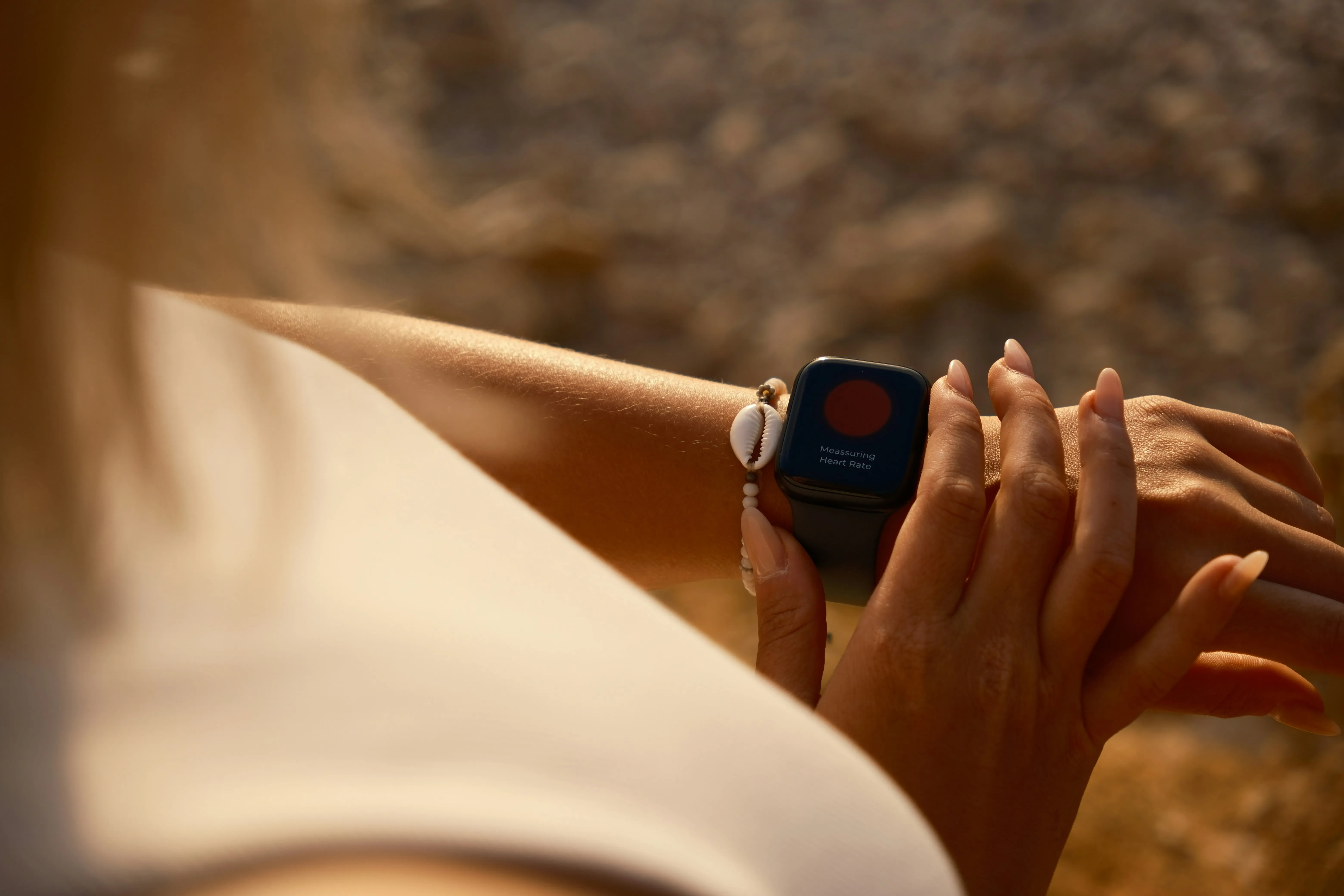
Your smartwatch shows a number labeled HRV. It changes every morning. Some days it’s high, some days it drops, and the app that displays it offers little explanation beyond “your body recovers differently each day.” That’s not very helpful.
Heart rate variability is one of the most useful health metrics available on a wrist, but most people either ignore it or obsess over the wrong things. This guide breaks down what HRV actually measures, why your personal trend matters far more than any reference chart, and how to use this single number to make better decisions about training, sleep, and recovery.
What is heart rate variability?
Heart rate variability, or HRV, measures the variation in time between consecutive heartbeats. Your heart doesn’t beat like a metronome. Even at a steady 60 beats per minute, the gaps between beats fluctuate by milliseconds. One interval might be 980 milliseconds, the next 1,040, the next 1,010.
These tiny fluctuations reflect your autonomic nervous system at work. Two branches compete for control of your heart in real time:
- The sympathetic branch speeds things up. It handles your stress response, fight-or-flight reactions, and physical exertion.
- The parasympathetic branch slows things down. It governs rest, recovery, digestion, and repair.
When both branches are active and responsive, the time between beats varies more. That’s high HRV. When one branch dominates, the intervals become more uniform. That’s low HRV. Stress and illness tend to lock the sympathetic side in control, which is why your HRV drops when you’re run down.
Higher HRV generally indicates that your body can adapt to changing demands. Lower HRV suggests your nervous system is under strain and less flexible.
Why HRV matters for your health
HRV has been studied in clinical and sports settings for decades. The evidence is consistent: higher resting HRV is associated with better cardiovascular health, greater resilience to stress, and improved recovery capacity.
A review published in Frontiers in Public Health found that HRV reflects autonomic nervous system dynamics and provides valuable insight into physiological adaptation, stress levels, and recovery status. The Cleveland Clinic notes that low HRV is linked to conditions including cardiovascular disease, diabetes, high blood pressure, and depression.
For athletes and fitness-minded people, HRV is a window into recovery. A 2025 narrative review on HRV monitoring in athletes concluded that daily or near-daily HRV assessment is recommended for optimizing recovery tracking and training adaptations. When your HRV is trending upward, your body is absorbing training stress well. When it’s trending downward, fatigue is accumulating.
How HRV is measured
Consumer wearables typically report HRV using one of two metrics:
SDNN stands for the standard deviation of normal-to-normal heartbeat intervals. It captures overall variability and is the metric used by Apple Watch and HealthKit. If you’re tracking HRV through an Apple Watch, the number you see is SDNN.
RMSSD stands for the root mean square of successive differences. It focuses on beat-to-beat changes and primarily reflects parasympathetic activity. Devices like WHOOP and Oura use RMSSD.
Both are valid time-domain measures of heart rate variability. They capture different aspects of the same phenomenon. Your SDNN number from an Apple Watch and someone else’s RMSSD number from an Oura Ring are not directly comparable.
A research review in Frontiers in Physiology found that RMSSD achieves acceptable reliability in recordings as short as 30 seconds, while SDNN requires at least four minutes for stable results. This is why some apps ask you to sit still for a few minutes when taking a spot measurement.
Why overnight HRV is more reliable
HRV fluctuates constantly throughout the day. Drinking coffee moves it. Walking upstairs moves it. A stressful email moves it. A single daytime reading captures your nervous system’s response to whatever just happened, not your underlying baseline.
Overnight measurement solves this problem. During sleep, your body is in a consistent state without the confounding variables of daily life. Parasympathetic activity dominates, especially during deep sleep, which is when HRV typically peaks.
Research published in Nature Scientific Reports confirmed that sleep quality and duration significantly affect overnight HRV patterns. A study in the American Heart Association’s Stroke journal found that lower nighttime HRV, measured as SDNN, was associated with increased stroke risk, reinforcing that overnight HRV is both reliable and clinically meaningful.
Wearables that measure HRV during sleep give you a cleaner, more consistent picture than any single morning or daytime reading.
What is a normal HRV range?
There is no single “good” number. HRV varies enormously between individuals based on age, genetics, fitness level, and overall health. Normal values span from below 20 ms to well over 100 ms.
That said, general patterns are consistent across research:
HRV by age, approximate RMSSD averages:
| Age group | Typical range |
|---|---|
| 20-25 years | 55-105 ms |
| 30-35 years | 45-85 ms |
| 40-45 years | 35-65 ms |
| 50-55 years | 25-55 ms |
| 60-65 years | 25-45 ms |
These ranges come from large datasets published by Kubios, WHOOP, and Elite HRV. The decline with age reflects natural changes in autonomic function: maximum heart rate drops, cardiac output decreases, and parasympathetic tone gradually weakens.
Young, highly trained athletes can show HRV values above 200 ms. Someone in their 60s with moderate fitness might sit around 30 ms and be perfectly healthy for their age.
The numbers above are reference points, not targets. What matters far more is your personal trend over time.
Your personal baseline matters most
This is the single most important thing to understand about HRV: your own baseline is more meaningful than any age chart or population average.
HRV is shaped by genetics you cannot change. Two people of the same age, fitness level, and health status can have baseline HRV values 30 to 40 ms apart. Comparing your number to someone else’s tells you nothing useful.
What tells you something useful is tracking your own 14-day rolling average and watching for deviations. A drop of 15% or more below your personal baseline consistently signals that something is off. Maybe it’s accumulated training fatigue. Maybe it’s poor sleep or chronic stress. Often it’s several factors stacking up at once.
Wildgrow uses a 14-day personal baseline with four status levels:
- Excellent: 10% or more above your baseline. Your body is well recovered and resilient.
- Normal: within 15% of baseline. Typical day-to-day variation, nothing to worry about.
- Low: 20% or more below baseline. Pay attention. Consider lighter training or extra rest.
- Attention: below 10 ms. Unusually low reading that warrants investigation.
This approach avoids the trap of fixed thresholds. A 25-year-old athlete with a baseline of 85 ms and a 55-year-old runner with a baseline of 38 ms both get actionable feedback based on their own physiology.
What affects your HRV
HRV responds to almost everything happening in your body and environment. Understanding these factors helps you interpret changes accurately instead of panicking over a single low reading.
Sleep is the strongest lever. Poor sleep quality and insufficient sleep duration both suppress HRV. Consistent sleep timing supports your circadian rhythm and keeps overnight HRV stable. If your HRV drops after a night of broken sleep, that’s your nervous system telling you it didn’t get the recovery it needed.
Exercise and training load create a predictable pattern. Hard sessions temporarily lower HRV. As your body recovers over the following hours and days, HRV rebounds. Over weeks and months of consistent training, your baseline HRV rises. If it doesn’t, you’re likely overreaching. Read more about managing training load and how it connects to recovery.
Stress drives HRV down through sustained sympathetic activation. This applies to physical stress and psychological stress equally. Chronic work pressure, relationship difficulties, or financial strain all show up in your HRV the same way a hard workout does.
Alcohol has a measurable and lasting impact. Research from WHOOP’s large user dataset suggests that even moderate drinking can lower HRV for up to five days. If your HRV drops on a Monday and you had drinks on Saturday, the connection is likely real.
Hydration and nutrition play a role. Dehydration reduces blood volume, which increases heart rate and suppresses variability. Eating large meals close to bedtime raises resting heart rate during sleep and lowers overnight HRV.
Illness and infection cause some of the sharpest HRV drops. Your immune system’s inflammatory response increases sympathetic activity, and HRV often falls before you feel sick. A sudden unexplained HRV drop can be an early warning sign.
Age and genetics set the baseline. You cannot change your genetic autonomic profile, and HRV declines naturally with age. But you can influence how fast it declines through exercise, sleep, and stress management.
HRV and recovery readiness
HRV becomes most powerful when you use it to guide daily decisions about training intensity. Rather than following a rigid schedule regardless of how your body feels, you can let HRV data tell you when to push and when to back off.
The logic is straightforward. When HRV is at or above your personal baseline, your parasympathetic system is in control and your body has recovered from recent stress. You’re ready for harder training. When HRV drops below your baseline, especially for multiple days in a row, accumulated fatigue is outpacing recovery. Easier sessions or full rest will serve you better than pushing through.
Wildgrow combines HRV data with sleep metrics and resting heart rate into a daily readiness score from 0 to 100:
- Good to Go (66-100): body is recovered. Train normally.
- Take It Easy (41-65): some fatigue present. Keep intensity low. Stay in heart rate Zone 1 or 2.
- Rest Day (0-40): significant fatigue. Skip training. Focus on sleep and recovery.
If your HRV drops 15% or more below your personal baseline, the readiness score is penalized by 15 points to reflect the recovery deficit. This means HRV doesn’t just inform the score, it actively adjusts your recommendations downward when your nervous system needs a break.
For more on choosing between light movement and complete rest, see active recovery vs. rest days.
How to improve your HRV
You cannot force your HRV higher overnight. But consistent habits compound over weeks and months, gradually raising your baseline.
Exercise regularly. Aerobic training is the single most effective way to improve HRV long-term. A review in Clinics found that regular aerobic exercise increases HRV and improves autonomic regulation of the heart. The key is consistency over intensity. Overtraining suppresses HRV just as surely as inactivity does.
Prioritize sleep. Go to bed and wake up at consistent times. Sleep consistency supports circadian rhythm and increases time in deep and REM stages, where parasympathetic activity is highest and HRV peaks.
Practice slow breathing. A systematic review and meta-analysis published in Neuroscience & Biobehavioral Reviews found that voluntary slow breathing increases vagally-mediated HRV both during breathing sessions and after multi-session interventions. Breathing at roughly six breaths per minute activates the parasympathetic nervous system through the vagus nerve.
Diaphragmatic breathing is the foundation technique. Wildgrow’s Breathworks feature includes guided sessions specifically designed to improve HRV through this mechanism. Even five to ten minutes a day can make a measurable difference.
Limit alcohol. Given the multi-day impact on HRV, reducing alcohol intake is one of the fastest ways to see your baseline improve.
Manage stress. Meditation, time in nature, social connection, and setting boundaries on work hours all reduce chronic sympathetic activation. Your HRV can’t recover if your nervous system never gets a break.
Stay hydrated. Drink enough water throughout the day. Dehydration forces your heart to work harder and reduces the variability between beats.
Common mistakes when tracking HRV
HRV tracking only works if you avoid a few common pitfalls that trip up most beginners.
Reacting to a single reading. One low HRV day doesn’t mean you’re overtrained or getting sick. HRV naturally fluctuates day to day. Look at trends over 7 to 14 days, not individual data points.
Comparing yourself to others. Your friend’s HRV of 85 and your HRV of 42 don’t mean they’re healthier. HRV is deeply individual. Your own trend is the only comparison that matters.
Switching devices and expecting consistent numbers. Different wearables use different metrics and different measurement windows. An Apple Watch reports SDNN while an Oura Ring reports RMSSD. Stick with one device to maintain a comparable baseline.
Measuring at inconsistent times. Daytime HRV is highly variable depending on recent activity, meals, and stress. Overnight or first-morning measurements give the most stable, comparable data.
Assuming higher is always better. In rare cases, an unusually high HRV reading can signal immune system activation at the onset of illness. It can also appear when your body is in a hyper-recovery state after extreme depletion. Context matters. A sudden spike is worth noting just like a sudden drop.
Track your HRV in Wildgrow
Overnight HRV tracking with a 14-day personal baseline, readiness scores, and guided breathwork to improve your recovery. Built on sports science. Free on the App Store.
Get Early AccessFrequently asked questions
Is high or low HRV better?
Higher HRV is generally better. It indicates your autonomic nervous system is balanced and adaptable. However, context matters. Low HRV during intense exercise is normal and expected. What you want is higher HRV at rest, especially overnight, which reflects good recovery and cardiovascular health.
What is a good HRV score for my age?
There is no single good score. HRV varies widely based on genetics, fitness, and health. A 25-year-old might average 70 ms while a 55-year-old averages 35 ms, and both could be healthy. Track your personal 14-day baseline and focus on your own trend rather than population charts.
Can stress lower my HRV?
Yes. Both physical and psychological stress increase sympathetic nervous system activity, which reduces heart rate variability. Chronic stress from work, relationships, or financial pressure suppresses HRV just like overtraining does. Stress management techniques like breathing exercises and meditation can help restore parasympathetic balance.
How quickly can I improve my HRV?
Most people see measurable changes in 4 to 8 weeks of consistent habits: regular exercise, quality sleep, slow breathing practice, and reduced alcohol. The fastest improvements often come from improving sleep consistency and cutting alcohol. Long-term aerobic training produces the largest and most sustained gains.
Does alcohol affect HRV?
Yes, significantly. Even moderate drinking can lower your HRV for up to five days. Alcohol disrupts sleep architecture, increases resting heart rate, and suppresses parasympathetic activity. If you’re trying to improve your HRV, reducing alcohol is one of the most effective single changes you can make.
Why does my HRV change so much day to day?
Daily fluctuations are completely normal. Sleep quality, exercise, meals, stress, hydration, and even weather can influence your reading. This is exactly why looking at a 7 to 14 day trend is more useful than any single measurement. Consistent overnight tracking reduces noise and helps you spot real patterns.
Sources
- Shaffer, F. & Ginsberg, J.P. (2017). An overview of heart rate variability metrics and norms. Frontiers in Public Health
- Cleveland Clinic. Heart Rate Variability (HRV): What It Is and How You Can Track It
- Laborde, S. et al. (2022). Effects of voluntary slow breathing on heart rate and heart rate variability: a systematic review and meta-analysis. Neuroscience & Biobehavioral Reviews
- Magnon, V. et al. (2022). Effect of resonance breathing on heart rate variability. Scientific Reports
- Tomes, C. et al. (2021). Applying heart rate variability to monitor health and performance in tactical personnel. Frontiers in Physiology
- Harvard Health Publishing. What is heart rate variability?
- Kubios. Heart Rate Variability: What is a Normal HRV Range?
- WHOOP. Heart Rate Variability: The Ultimate Guide